If you spend a lot of time at home with your toddler, you have probably wondered whether you should be doing more to help their speech. I remember that feeling well — watching other children chat away and quietly worrying I was missing something. What I have learned is much simpler and kinder: you do not need flashcards, special apps, or a strict plan. Everyday talk, play, and time together are already the best tools you have.
Toddlers develop at very different rates, and that is completely normal. One child might use two-word phrases just after age two while another is still happily using single words and gestures. Both can be doing just fine. No activity can cure a delay or guarantee a certain outcome. What these ideas can do is give your toddler gentle chances to listen, copy, and practise — and that practice helps build speech in a natural way.
Quick Answer
The best activities are simple and part of normal life: narrate your day in short phrases, expand on the words your toddler already says, offer choices, wait patiently for a reply, copy their sounds and add one more word, sing songs with actions and pauses, share picture books without quizzing, and enjoy pretend play and turn-taking games. Get down to their level so they can see your face, and turn off background noise when you can. Little moments, repeated through the day, can support your toddler far more than any worksheet or app.
Narrate Your Day in Short Phrases
Talk about what is already happening. This is sometimes called a running commentary. As you make lunch, try: “Mummy is stirring. Hot soup. Blow, blow.” While getting dressed: “Socks on. One sock, two socks. Shoes next.”
Keep phrases short — just a little longer than what your toddler can say. If they mostly use single words, two or three word phrases are perfect. You are not teaching a lesson, just wrapping their world in words. Hearing the same useful words in the same routines gives them a strong base to copy when they are ready.
Expand on What Your Toddler Says
When your toddler says a word, repeat it back and add a little more. If they say “car,” say, “Yes, a big red car.” If they say “juice,” try “More juice, please” or “Yummy apple juice.”
You are not correcting them. You are showing them the next small step, warmly and naturally. Hearing their own idea turned into a slightly longer sentence gives them something new to try, with no pressure.
Offer Choices to Invite a Response
Choices invite communication. Hold up two options and ask, “Milk or water?” or “Banana or toast?” Even if they only point or look at the one they want, that is still communication. Model the word back: “Water! You chose water.”
Ask questions where they truly get to decide. It makes talking feel useful, which is a powerful reason for a small child to keep trying.
Wait, Copy, and Give Time to Answer
This one is hard, and I still remind myself to do it: after you ask something, pause and wait. Count slowly to ten in your head. Toddlers need much more time than adults to understand and find a response. If we jump in too quickly, we can take their turn away.
Look at them, smile, and keep your face interested. That pause says, “I think you have something to say.” Sometimes they will surprise you with a sound or word. Sometimes they will just smile — and that shared moment still matters.
Copy Their Sounds and Add One More
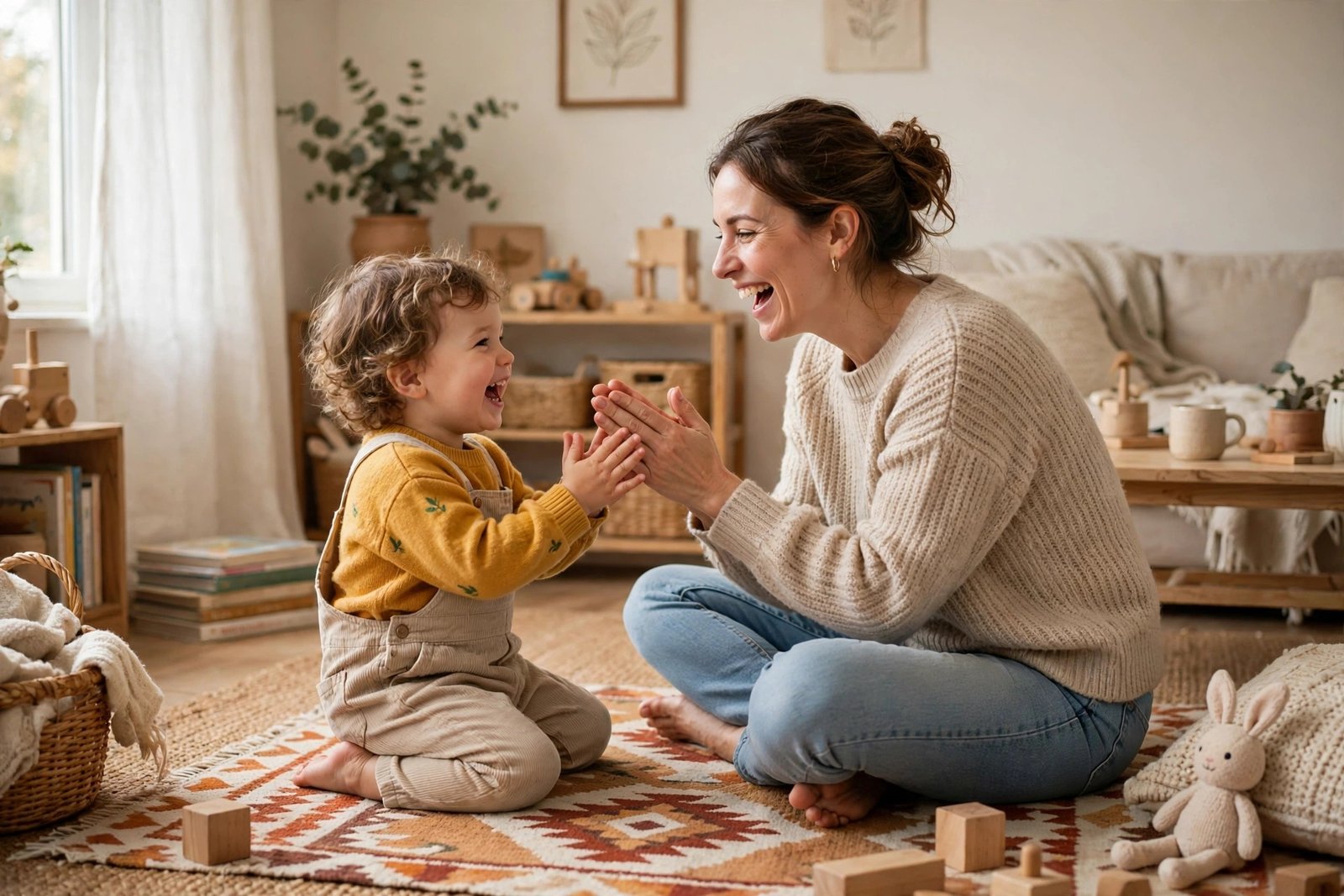
Copying is how conversation starts. If your toddler bangs a spoon and says “ba!”, copy the bang and the “ba!”, then add one more: “Ba-ba-ball.” If they make car noises, get down and join in, then add “Beep beep, car goes fast.”
When you copy them first, they often copy you back. That back-and-forth helps build confidence, because they feel listened to.
Songs, Rhymes, Books, and Pretend Play
Songs and nursery rhymes help because they are full of rhythm, repetition, and predictable words. Action songs like “Wind the Bobbin Up,” “Row, Row, Row Your Boat,” and “Head, Shoulders, Knees and Toes” give actions to copy even before words come. Try pausing before a favourite word — “Twinkle, twinkle, little…” — and wait. Many toddlers will fill the gap with a sound, gesture, or word when they are ready.
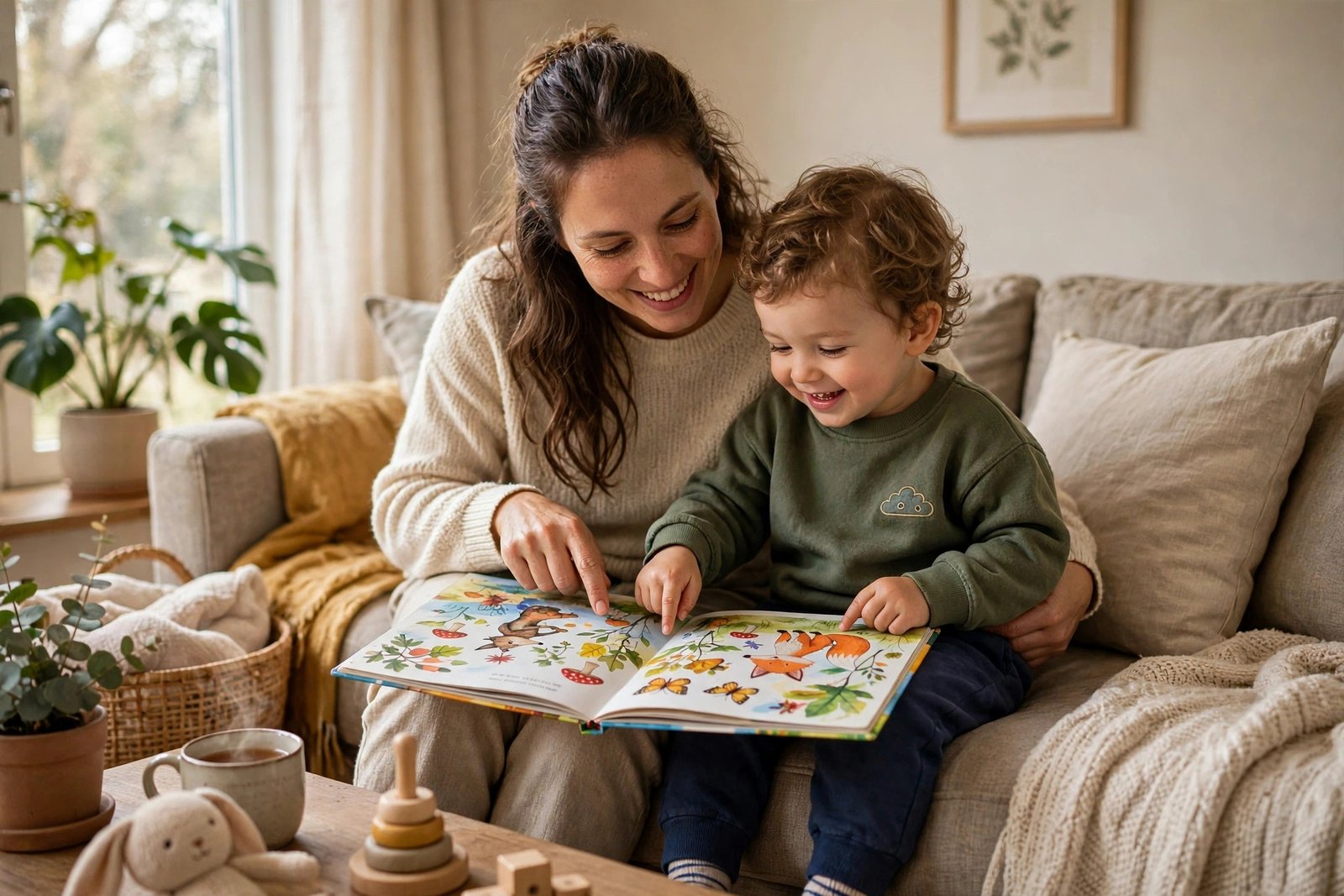
Picture books work in a similar gentle way. You do not need to read every word. Point, name, and follow their interest: “Look, a dog! Woof woof. The dog is sleeping.” Let them turn pages and point. Try not to quiz with lots of “What’s this?” questions — comment instead on what they are looking at. Five cosy minutes together can be more useful than a long session neither of you enjoys.
Pretend Play and Toy Phones
Pretend play gives toddlers endless things to talk about. With a toy phone you can model “Hello? Who is it? Oh, it’s Grandma! Bye bye!” and pass it back and forth. Tea parties, feeding a teddy, or pretending to cook create natural chances for words like “more,” “hot,” “yum,” and “all gone.”
Play does not need to be fancy. Some of our best talking time has come from very simple sensory play ideas at home, like scooping dried pasta, pouring water between cups, or hiding a toy in a box of scarves. When hands are busy and a child is interested, words often follow.
Turn-Taking Games
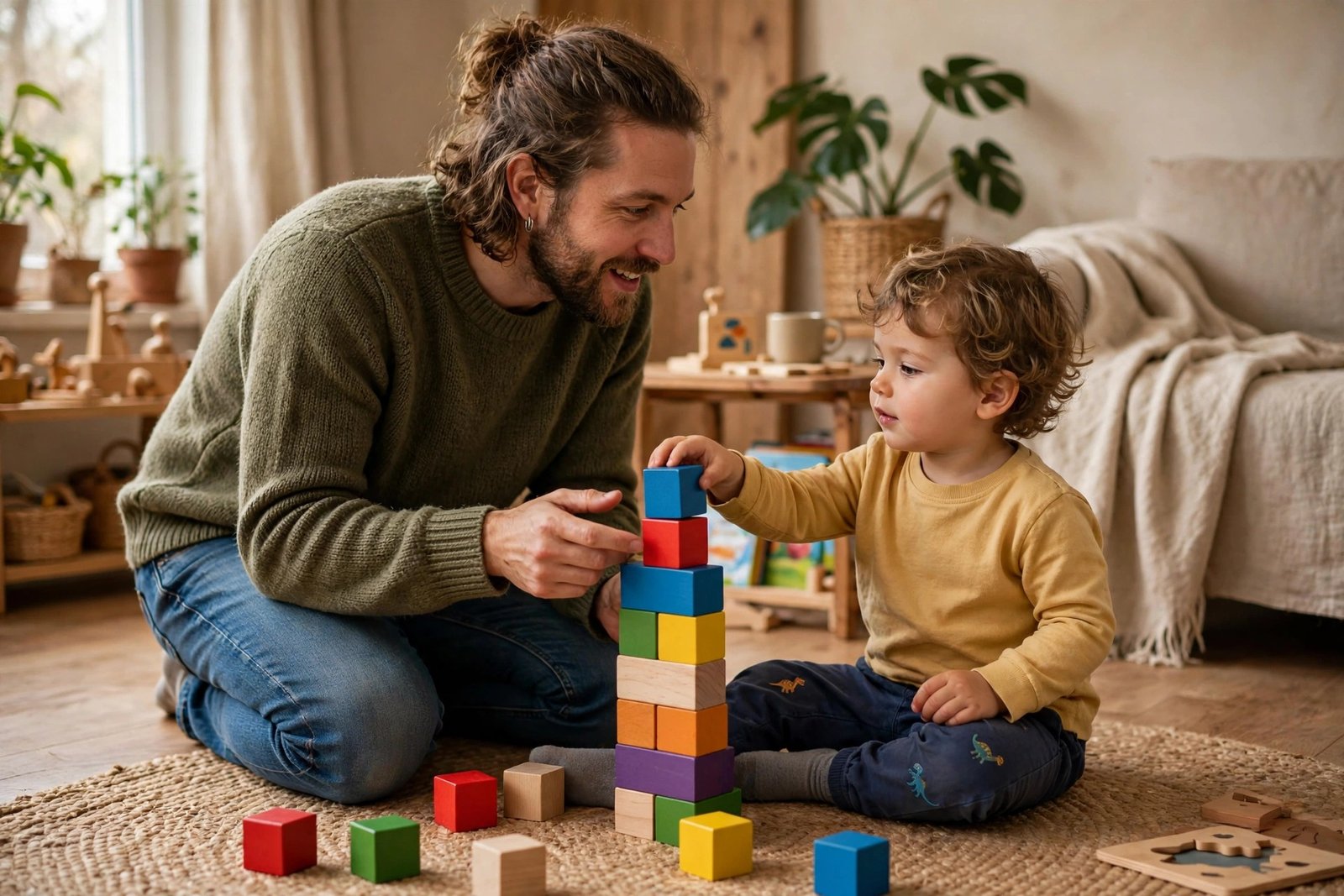
Turn-taking is the heart of conversation, and games teach it without words needing to be perfect. Roll a ball back and forth (“Your turn… my turn!”), post shapes into a box one at a time, take turns adding a block to a tower, or play peekaboo with pauses.
These games help your toddler practise waiting, watching, listening, and having their own go — the skills underneath talking. Keep them short and silly, and stop while you are both still having fun.
Get Face to Face and Make Talk Easier to Hear
Get down to your toddler’s level whenever you can. Kneel, sit on the floor, or sit them safely at a table so you are face to face. When they can see your mouth, eyes, and expressions, it is easier to copy sounds and understand feelings. It also feels warmer — you are in their world, not calling down to it.
Noise matters too. Background television can make it much harder for a small child to pick out your voice. Turning it off during play and chatty times does not need to be an all-day rule, but quieter moments help. My guide to toddler screen time limits shares how we found a balance that works on real, tired days.
If your toddler uses a dummy or pacifier, you might gently keep it for sleep and comfort times and have it out during chatty play, so their mouth is free to babble and try words. This is not a strict rule — comfort matters too — just something many families find helpful.
On long afternoons, having activities ready takes the pressure off. I keep a list of toddler bored at home rainy day activities for those moments, because relaxed play often leads to the most natural chatting of all.
Mistakes to Avoid
- Quizzing constantly with “What’s this?” — commenting is usually more helpful and less pressured than testing.
- Using flashcards or apps with pressure to perform, rather than playing and talking together.
- Correcting pronunciation harshly or making your toddler repeat a word “properly” — instead, model it back correctly in your own sentence.
- Finishing every sentence for them, or answering before they have had time to try.
- Comparing them with siblings, cousins, or children online — toddlers develop at very different rates.
- Having lots of background screen time and noise when you most want to chat and play.
- Worrying in silence — asking for advice early is always better than waiting and worrying alone.
When to Ask for Help
Trusting your instincts and asking early is a strength, not an overreaction. Early support helps, and asking never harms your child. Many late talkers catch up in their own time, but you do not have to wait and worry alone to find out.
Ranges vary, and every child is different, but speak to your health visitor or GP if you notice: no babbling by around 12 months; no single words by around 16 to 18 months; no two-word phrases, like “more juice,” by around 2 years; or losing words or skills at any age — ask promptly about that last one. Also ask if your toddler does not respond to their name or to sounds, or if you worry about their hearing, as hearing checks are an important first step.
Your health visitor or GP can listen and, if needed, refer you to a speech and language therapist. That is simply a way to get the right support and ideas. It is not about labelling or diagnosing — it is about not carrying worry alone when help is there.
Frequently Asked Questions
How much talking practice does my toddler need each day?
There is no set number of minutes. Little and often through normal routines — meals, bath time, getting dressed, play — is plenty. Short, happy moments where your toddler is interested can support speech far more than one long, pressured session.
Should I correct my toddler when they say a word wrong?
It is kinder not to correct them directly. Just say the word back the right way in a natural sentence. If they say “tat” for cat, smile and say, “Yes, a cat! A soft cat.” They hear the correct sound without feeling they got it wrong.
Do educational apps and flashcards help toddler speech?
They are not needed, and they cannot replace real conversation. Toddlers learn language best from back-and-forth talk with a caring adult who responds to them. Everyday chat and play should be the main focus.
What if my toddler understands everything but says very little?
Understanding is an important skill and a good sign your child is taking language in. Still, if they say much less than you expect for their age, or you feel worried, mention it to your health visitor or GP. Asking early means reassurance or support sooner.
This article shares general information and personal experience only and is not medical advice. If you are worried about your child’s speech, please speak to your doctor or health visitor. Read more in our full disclaimer.