
I still remember sitting in my kitchen with a tiny bowl of sweet potato, a small spoon, and a baby who looked at me as if I had changed all the rules. I had lists everywhere and still felt unsure. How much should I offer? What if she pushed it all out? What if she gagged?
If you feel the same, take a breath. The first four weeks are not about perfect meals or empty bowls. They are about slow tastes and letting your baby learn at her own pace. Milk is still doing the main job; food is practice.
Here is the simple plan that helped me, with the safety basics I wish I had known on day one.
Quick Answer
Start with a few spoonfuls of a single-vegetable purée or soft mash once a day, when your baby is calm and not too hungry or tired. In week 1, try one vegetable at a time. In week 2, add soft fruits and thicken textures a little. In week 3, add soft finger foods and an iron-rich food. In week 4, introduce common allergens carefully, one at a time. Breast milk or formula stays your baby’s main nutrition through the first year, so amounts stay tiny at first and there is no rush. Always seat your baby upright in a highchair, stay close while she eats, and offer food with no added salt or sugar and no honey before 12 months.
Before You Start
Most babies are ready at around six months, but readiness is about signs, not just the calendar. Your baby should sit with support, hold her head steady, show interest in food, and bring objects to her mouth. If you are still deciding, my guide on when to start weaning your baby helped me settle my nerves.
Pick a relaxed time. Late morning worked best for us, after a milk feed and a play. At first, offer food between milk feeds, not instead of them. You only need a highchair, two soft spoons, a small bowl, bibs, and something easy to clean under the chair.
Gagging and Choking: The Difference That Matters
This was my biggest fear, so I want to explain it clearly.
Gagging is noisy and normal. Your baby may cough, splutter, retch, push food forward with her tongue, and go a little red. This protective reflex helps her learn to move food safely. Stay calm, stay close, and let her work it out.
Choking is quiet and is an emergency. A choking baby may be silent or barely able to cough and may struggle to breathe. That quiet is the key difference: noisy is usually gagging, silent is serious.
To lower risk, always supervise eating, keep your baby seated upright in a highchair, and never leave a baby alone with food. Never offer food in a moving car seat, a bouncer, or while she is lying back.
Week 1: Single Vegetables, Tiny Tastes
The goal is one small taste a day, just a few spoonfuls, with one vegetable at a time. I started with vegetables so my baby met savoury flavours first, but simple and single matters more than any perfect order.
Good first ideas:
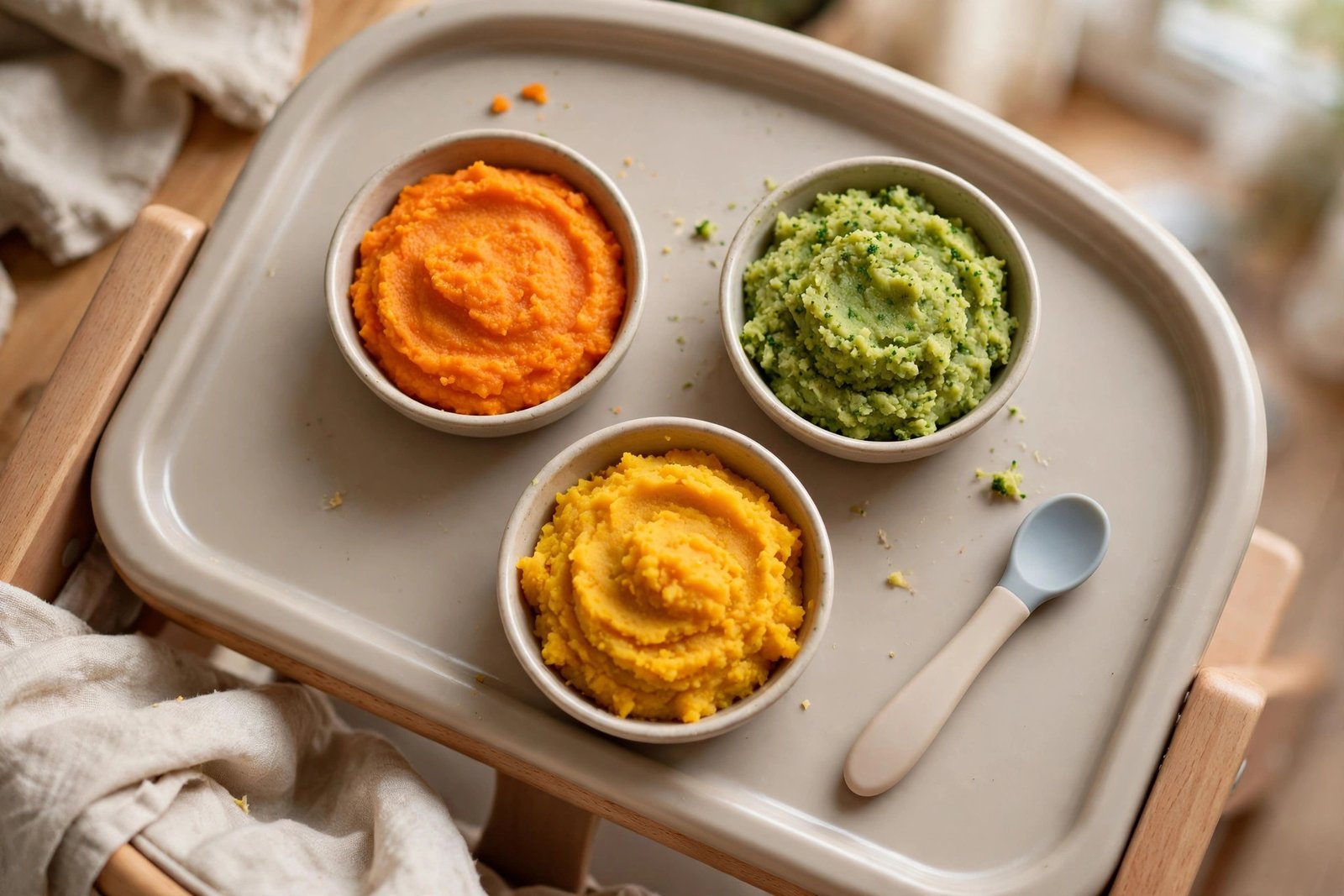
- Sweet potato, steamed and mashed smooth with a little of her usual milk or boiled water
- Carrot, steamed and puréed with no lumps
- Broccoli, steamed until very soft and blended smooth
- Courgette or butternut squash, steamed and mashed smooth
Offer two or three spoonfuls and let your baby lean in. If she turns away or closes her mouth, that is enough for today. Do not coax spoon after spoon into a mouth that is saying no. Mine spat out her first spoonful of carrot, smiled, and grabbed the spoon itself. That counted as a good day. Expect stools to change a little as her tummy meets something new.
Week 2: More Variety and First Fruits
Keep one meal a day, or move to two small meals if your baby is keen. By week 2, my baby knew what the spoon meant and gagged less. Continue vegetables, make them a little thicker, and add a soft fruit on some days.
Simple ideas:
- Pear, steamed if firm, then mashed
- Banana, ripe and mashed with a fork
- Apple, stewed with no added sugar and puréed
- Avocado, ripe and mashed smooth
Move slowly from runny purée toward a thicker mash, only as your baby manages comfortably. If she struggles, go back to smoother for a few days.
Wind can increase as the tummy learns too. Tummy time and gentle bicycle legs helped us, and on fussy afternoons I used the ideas in my guide on how to help a gassy baby. Extra wind alone is not usually a reason to stop.
Week 3: Soft Finger Foods and Iron-Rich Foods
Now add soft finger foods alongside mashes, and include an iron-rich food most days. Finger foods should be soft enough to squash between your fingers and long enough for a small fist to hold.
Gentle ideas:
- A steamed broccoli floret with a stalk handle, cooked very soft
- A thick stick of steamed sweet potato or carrot, soft enough to squish
- A stick of ripe avocado or banana
- Well-cooked pasta spirals, plain and soft
From around six months, your baby’s iron stores start to run lower, so small regular tastes of iron-rich foods help. Try lentil purée, well-cooked minced meat in a mash, flaked fish with every bone removed, or iron-fortified cereal made with her usual milk. Pair lentils with a vitamin C food like broccoli or pear to help her body use the iron.
Keep safety rules at every meal. Cut grapes and cherry tomatoes lengthwise into quarters; never serve them whole. Give no whole nuts under five; use smooth nut butters thinned with water or milk instead, as in week 4. Give no honey before 12 months, and add no salt or sugar.

Week 4: Confidence and Allergens, Carefully
By week 4, settle into two, or sometimes three, small meals if your baby is keen. She will have favourites, dislikes, and days when she eats almost nothing and only wants milk. Those days are normal, and milk still fills the gaps.
Now introduce common allergens, with care rather than fear. Start with well-cooked egg or peanut, one at a time, in a small amount, earlier in the day so you can watch for a few hours. Stir a quarter teaspoon of smooth peanut butter, thinned well, into a known purée, or offer hard-boiled egg mashed very soft. If there is no reaction, increase gradually and keep offering it regularly.
I cannot promise early introduction will prevent an allergy, and no plan can. If your baby has moderate to severe eczema, a known allergy, or a strong family history of allergy, ask your doctor first before introducing allergens at home. If she reacts, stop that food and get medical advice before offering it again.
Stools often become firmer this month. My notes on baby constipation helped me tell normal changes from hard stools passed with pain or blood in the stool, which always need medical advice.
Mistakes to Avoid
- Starting with a full bowl. Start with a few spoonfuls and add more only if your baby wants it.
- Cutting milk feeds too fast. Milk stays the main nutrition in the first year; food grows slowly around it.
- Adding salt, sugar, or honey. Plain is right for babies, and honey waits until after 12 months.
- Serving risky shapes: whole grapes, whole cherry tomatoes, whole nuts, hard chunks, or round slices.
- Introducing several allergens on one day, so you cannot tell what caused a reaction.
- Leaving your baby alone to eat, even briefly, or feeding her lying back or on the move.
- Forcing the spoon when she turns away or cries. Stopping is fine; tomorrow is another chance.
- Giving up on a flavour after one grimace. New tastes can take many gentle, pressure-free tries.
When to See a Doctor
Trust your instincts. You know your baby’s normal. Contact a doctor promptly, and seek emergency help where noted, if you notice:
- Allergic-reaction signs after a new food, such as swelling of the lips, face, or tongue, widespread rash or hives, repeated vomiting, or unusual paleness or floppiness.
- Difficulty breathing or swelling of the tongue after eating. This is an emergency. Call your local emergency number straight away.
- Poor growth or feeding worries: weight loss, not following her growth curve, refusing almost all milk and food, or ongoing worry that she is not taking enough.
- Persistent vomiting, diarrhoea that does not settle, blood in the stool, or dehydration signs such as far fewer wet nappies or unusual sleepiness.
- Hard, painful stools or a swollen tummy that does not ease.
- Choking that does not clear, or repeated coughing during feeds that worries you.
If you are unsure, call your doctor or health visitor. Asking early is never wasting time.
Frequently Asked Questions
How much should my baby eat in the first few weeks?
Very little, and that is expected. A few spoonfuls once a day is a perfect start. Some babies take a tablespoon or two by week 4; others still mostly taste and spit. Follow your baby’s cues, not a set amount.
My baby gags on every spoonful. Should I stop?
Mild, noisy gagging is normal while babies learn, and it usually eases in a couple of weeks. Keep portions small and smooth and let her set the pace. If gagging is constant, she vomits often, coughs a lot during feeds, or you feel frightened at most meals, speak to your doctor.
Can I give peanut butter in the first month?
Yes, with care. Use smooth peanut butter only, never whole or chopped nuts, thin it well so it is not sticky, start with a tiny amount earlier in the day, and watch for reactions. If your baby has severe eczema or a strong family allergy history, ask your doctor first.
What if my baby refuses a food or a whole meal?
Offer once without pressure, end the meal kindly, and give milk as usual. Try again another day. Refusal is communication, not bad behaviour. Refusing almost everything, with poor growth or distress, is a reason to see your doctor.
This article shares my personal experience as a mum and is for general information only. It is not medical advice and does not replace advice from your own doctor or health professional. Please read our full disclaimer and always seek qualified help for concerns about your baby’s feeding, growth, or health. With love, Daisy.