
If your baby has just gagged on a lump of food, I completely understand why your heart was in your mouth. I still remember sitting frozen by the highchair, wondering whether to reach in and help or wait. Gagging looks and sounds dramatic, and when you are new to weaning it is hard to tell what is normal learning and what needs urgent help.
The good news is that gagging is a normal, protective part of learning to eat. Most babies gag when textures change, then carry on happily. The key skill for parents is spotting the difference between gagging and choking, responding calmly, and progressing textures in small, safe steps.
Quick Answer
Gagging is normal and noisy. Your baby coughs, retches, pushes food forward with their tongue, and may have watery eyes. It is a protective reflex, and babies usually sort it out themselves if you stay calm and close. Choking is different and quiet. A baby who is choking cannot cough, cry, or breathe properly and needs emergency help straight away. If you are ever unsure, treat it as an emergency. Progress slowly from smooth purée to mashed food with soft lumps, then to soft finger foods that pass the squish test, always supervising with your baby seated upright.
Gagging vs Choking: How to Tell the Difference
What Gagging Looks and Sounds Like
Gagging is your baby’s built-in safety system. When a lump goes further back than your baby expects, the gag reflex pushes it forward so it can be chewed more or spat out. Typical signs include:
- Loud coughing, spluttering, or retching sounds
- The tongue pushing forward, sometimes pushing food out of the mouth
- Watery eyes, a red face from coughing, and sometimes a small vomit
- Making noise and moving air, and often recovering in a few seconds
Noise is reassuring here: a baby who can cough loudly is moving air. After a gag, many babies happily reach for the next mouthful.
What Choking Looks and Sounds Like
Choking happens when food blocks the airway. It is much rarer, but it is an emergency. Warning signs include:
- Quiet or silent struggling, with little or no sound
- Unable to cough effectively, cry properly, or breathe normally
- Wide, panicked eyes, weak movements, or going pale or blue around the lips
- Food is not coming forward, and your baby is not recovering alone
I remember it this way: loud and red, let them work it out under your watch. Quiet and struggling to breathe, act immediately.

What to Do When Your Baby Gags or Chokes
If Your Baby Is Gagging
Try to stay calm, even if your stomach drops. Your baby watches your face, and a calm voice helps them stay calm too. Stay close and give them a moment to cough and work the food forward themselves. Gagging usually settles within seconds.
Please do not blindly fish food out with your fingers. Sweeping a finger into your baby’s mouth without seeing clearly can push food further back. Only remove food if you can see it clearly and pick it out easily. If your baby returns to normal, take a short break, then continue gently.
If You Think Your Baby Is Choking
If your baby cannot cough, cry, or breathe properly, call your local emergency number immediately, or ask another adult to call while you help your baby. Give age-appropriate first aid only as you have been trained, until help arrives or your baby recovers.
Choking needs hands-on training to learn properly, so the best step you can take before you need it is a baby and child first-aid course, ideally before weaning starts. Practising on a manikin gives you confidence that reading alone cannot. Save emergency numbers in your phone and encourage anyone who regularly feeds your baby to learn the basics too.
Why Gagging Happens When Textures Progress
Gagging almost always increases for a short while when textures change. Smooth purée is easy to suck and swallow in one movement. Lumps, mash, and finger foods ask your baby to do much more: move food side to side with the tongue, chew with the gums, gather it together, and only then swallow.
Until those skills click, the gag reflex steps in early and often. It sits further forward in a young baby’s mouth than in an adult’s, which is why babies gag more easily. That is protective by design. With practice, the reflex becomes less sensitive and gagging happens less often. If you are still planning those earliest tastes, our baby’s first foods week-by-week plan shows how textures build up over time, so there is no need to rush.
How to Progress Textures Step by Step
Think of textures as a staircase, not a leap. Spend several days on each step. Going back a step after illness or a big gag is fine.
Step 1: Smooth Purée
Start with smooth purées that slide off the spoon easily. If you are wondering whether your baby is ready to begin, our guide on when to start weaning your baby covers the signs of readiness to check first.
Step 2: Mashed Food with Soft Lumps
Next, mash foods with a fork instead of blending them smooth. Think mashed banana, avocado, sweet potato, or soft cooked vegetables. Lumps should be tiny and very soft. Stir some smooth purée through at first if needed.
Step 3: Minced Food and Soft Finger Foods
From there, move to finely minced family foods and soft finger foods your baby can hold. Finger foods are wonderful for chewing practice, because your baby controls what goes in and how fast.
The Squish Test
Before you serve any finger food, do the squish test. Press it between your thumb and finger. It should squash easily under gentle pressure. If you have to force it, it is too hard for now: cook it longer, mash it more, or save it for later weeks.
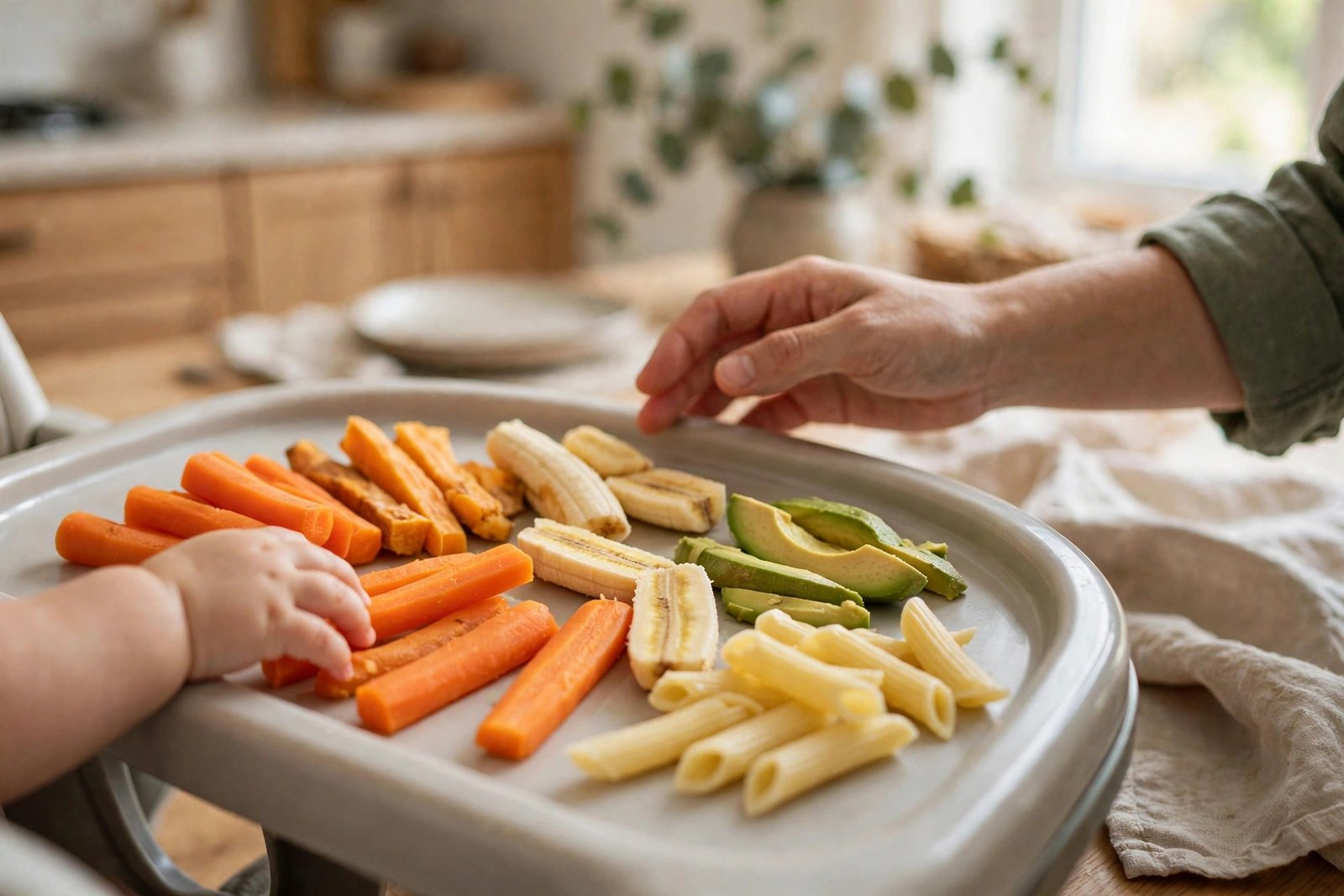
Good First Finger Foods to Try
- Soft steamed carrot, sweet potato, broccoli, or courgette sticks, about finger length for gripping
- Strips of ripe banana or ripe avocado, which are naturally soft
- Well-cooked soft pasta shapes, or strips of toast with a soft topping
- Soft ripe pear or melon sticks, with hard skin removed
Foods and Shapes to Avoid
- Whole grapes and whole cherry tomatoes: always quarter them lengthwise, from top to bottom, never across into round slices
- Whole nuts: do not give these to children under 5. Spread nut butters thinly, never in thick spoonfuls
- Hard raw chunks, such as raw apple or raw carrot, that do not pass the squish test
- Whole sausages and round slices: cut sausages lengthwise into thin strips, never into coin-shaped rounds
- Popcorn, whole marshmallows, and hard sweets, which are best avoided for babies and toddlers
Mealtime Safety Rules I Never Skip
- Always supervise and watch your baby eat for the whole meal
- Always seat your baby upright in a highchair with the harness done up
- Never let your baby eat in a moving car or moving pram, where you cannot help quickly
- Keep meals calm and seated, with no eating while crawling, walking, or lying down
- No honey under 12 months, including in cooked foods, because of the risk of infant botulism
- Serve small amounts at a time, so the mouth is not stuffed too full
Mistakes to Avoid
- Moving too fast: jumping from smooth purée straight to firm chunks gives no time to learn chewing
- Fishing blindly in the mouth: this can push food further back. Let the cough do its job during a gag
- Panicking at every gag: babies can become anxious if adults gasp and grab each time. A steady, encouraging face helps
- Offering round, hard, or whole foods: always quarter grapes lengthwise and never serve whole nuts
- Leaving your baby alone to eat: even confident eaters must always be watched
- Forcing another spoonful after a big gag: pause, offer comfort, and try again later
If meals are turning into battles, our advice on a baby refusing solids may help you rebuild confidence at the table.
When to See a Doctor
Most gagging is normal, but please speak to your doctor, health visitor, or paediatric team promptly if you notice:
- Regular gagging or vomiting at most meals that does not improve
- Coughing during milk feeds too, or a wet, gurgly voice
- Poor weight gain, very long feeds, or distress at most feeds
- Clear difficulty swallowing, or repeated chest infections
- Any choking episode where your baby needed help, even if they seem fine afterwards
- Ongoing fear of food, or strong refusal of all lumps beyond the early weeks
You know your baby best, so please do not wait before asking. A quick check is always worthwhile.
Frequently Asked Questions
Is it normal for my baby to gag at every meal when we start lumps?
Yes, in the early days of a new texture it can happen several times in one meal. For most babies it reduces over one to two weeks of practice as chewing improves. If it stays severe, causes regular vomiting, or your baby is not gaining weight well, speak to your doctor or health visitor.
Should I stop finger foods if my baby keeps gagging?
Usually no. Step back to a softer texture for a few days, check every piece passes the squish test, and offer smaller, softer sticks. Avoiding finger foods altogether can make gagging last longer, because babies need practice to learn chewing. If gagging is extreme, pause and get medical advice first.
How do I cut grapes and cherry tomatoes safely?
Cut each one lengthwise into quarters, from top to bottom, so they are long and thin rather than round. Never serve them whole and never cut them across into round discs, because round pieces can block an airway. Keep doing this for young children, and always supervise.
When will the gagging stop?
There is no exact day, because every baby develops at their own pace. Most parents notice much less gagging after a few weeks of regular practice, as the gag reflex becomes less sensitive and chewing gets stronger. Occasional gagging can still happen in toddlerhood and is usually nothing to worry about if your child recovers quickly.
This article is for general information and parent-to-parent support only and is not medical advice. If you are worried about your baby’s feeding, swallowing, growth, or breathing, please speak to your doctor or health visitor promptly, and in an emergency call your local emergency number. Read more in our full disclaimer.